

The airline industry is constantly evolving, and CUPE members are on the front lines of that change. Whether it’s difficult collective bargaining, precarious working conditions, in-flight safety or other workplace health and safety concerns, CUPE’s Airline Division remains united and mobilized.
CUPE has made many important gains in recent years, but there is still a lot at stake for its 20,000 members across 11 Canadian airlines.
A new era at Porter Airlines
Last August, the Canada Industrial Relations Board (CIRB) approved CUPE’s application for certification to represent some 1,200 flight attendants at Porter Airlines.
In the fall, elections were held to choose the executive of CUPE 4061.
“I’m so proud of my colleagues who have spent countless hours organizing for this win,” said Sarah Seal, president of the local representing Porter Airlines’ cabin crew. “This is an exciting new chapter for all of us, and we look forward to improving our working conditions and wages as Porter continues to grow and succeed.”
Newly elected, the representatives have already taken part in several CUPE training sessions and are now preparing for a historic next step: negotiating their very first collective agreement.
A busy fall at WestJet
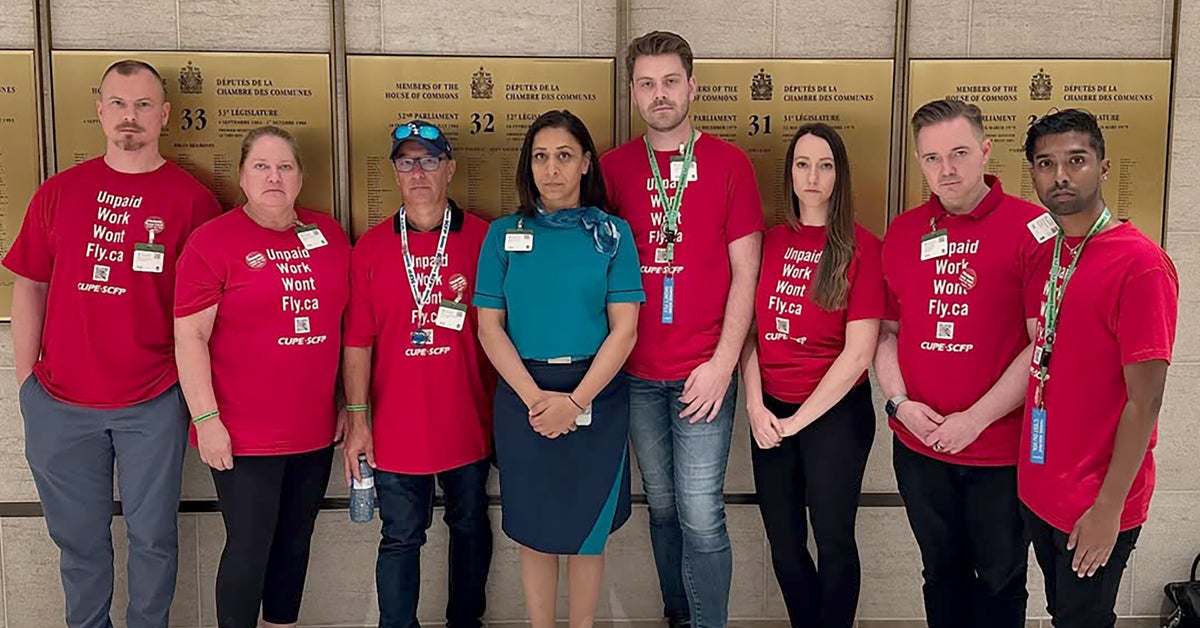
Last fall was a busy one for the 5,000 members of CUPE 8125, the local representing WestJet flight attendants. After taking part in a powerful mobilization on Parliament Hill to denounce unpaid work, the local executive began bargaining a new collective agreement to replace the one that expired on December 31, 2025.
At the same time, a new campaign was launched to shine a light on WestJet cabin crew working conditions. Titled UltraExtraBasic, the campaign encourages the public to remind WestJet what CUPE’s Airline Division members have been repeating for years: unpaid work is simply unacceptable.
“WestJet flight attendants go above and beyond to keep passengers safe and comfortable, yet they aren’t being fairly compensated for their time,” said Alia Hussain, president of CUPE 8125. “This campaign is about respect, fairness and restoring dignity to our people and our profession.”
Support the campaign: ultraextrabasic.ca/
Strike at Pascan Aviation
On October 28, CUPE 5490, representing 21 flight attendants at Pascan Aviation, went on strike. The collective agreement with the airline, which operates in Quebec and Canada’s Eastern provinces, expired on July 18, 2025. Key issues include wages, off-base accommodations, work assignments and crew scheduling.
On the second day of the strike, the union learned that Pascan Aviation had never intended to bargain in good faith. As early as April 2025, the airline is alleged to have approached individuals to replace flight attendants in the event of a strike.
Since the beginning of the strike, pilots and administrative staff have been operating flights in place of cabin crew after just two days of training — rather than the full flight attendant training program, which takes several weeks and is required to master various complex emergency procedures. This practice is not only dangerous for workers and passengers but is also prohibited under new federal anti-scab legislation.
“We find it deplorable that the company had no interest in giving negotiations a chance,” said Jessé Vigneault, president of CUPE 5490. “While we were working on bargaining, and before we even submitted our list of demands, the company was already looking for people to replace us.”
Layoffs at Canadian North:
In November 2025, Canadian North management announced the layoff of 13 cabin crew members. CUPE 8111, which represents the airline’s 196 flight attendants, had already put forward several solutions — including reduced schedules and enhanced retirement programs — to avoid job losses ahead of the holiday season.
Despite these constructive proposals, management chose to turn a deaf ear, walking away from options that would have protected jobs while still meeting the airline’s operational needs.
Canadian North serves 24 Northern communities in Nunavut and the Northwest Territories via Ottawa and Edmonton, and also operates charter flights in northern Alberta and British Columbia.
“Our flight attendants are deeply passionate about their work, the North and the passengers they serve,” said Isabelle Paquette, president of CUPE 8111. “Losing the strong personal connections our members have built with the communities and travellers they support makes the impact of these potential job losses especially profound.”
Air Canada: a campaign for cabin air quality
After their historic strike, members of CUPE’s Air Canada Component launched a campaign on cabin air quality in November 2025. Toxic fume events on board are a serious issue for flight crews.
When an aircraft flies above 8,000 feet (2,438 metres), the cabin must be pressurized so that people on board can breathe normally. In jet aircraft (with the exception of Boeing 787), cabin pressurization is achieved by injecting a small amount of highly pressurized air from the engines into the cabin air supply system.
Under normal conditions, this is fresh air drawn from the engine compressor, not mixed with fuel or exhaust gases. Unfortunately, that is not always the case.
For more than 60 years, it has been known that engine malfunctions can allow chemicals to enter the cabin and lead to significant exposure to toxic fumes on board.
Because of their work, cabin crew are at high risk of exposure to these incidents, and risks are often not taken seriously by airlines.
With the campaign Would you like some fumes with that?, the Air Canada Component and CUPE are reaffirming their commitment to put cabin crew health and safety first, and to build resources for responding to toxic fumes exposure.
The past year has shown just how essential solidarity and mobilization remain to improving working conditions across the airline sector. By raising their voices together, CUPE flight attendants share a common goal: ensuring their work is recognized at its true value and maintaining a safe flying environment for everyone on board. Members are bringing that same determination into 2026, standing shoulder to shoulder to rise to the new challenges facing their industry.