
Local Health Integration Networks (LHINs) will mean
big changes in how health and some social services
are funded and delivered in Ontario.
The McGuinty Liberals introduced Local Health
Integration Networks (LHINs) last year as part of their
plan to transform the way a variety of health care and
some social services will be funded and delivered in Ontario.
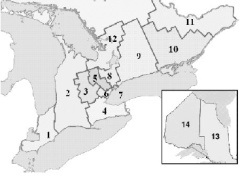
By 2007/08, the Liberals intend to use the 14 LHINs set
up across the province to fund, redistribute, merge and
cut a variety of health and social services including
hospitals, nursing homes, homes for the aged, and
addiction, mental health and child treatment services.
Top 5 reasons why LHINs are bad for your health
- There’s nothing local about LHINs — less access to health services,
further away from your community
The Liberals call their plan for LHINs, health service “integration.” But LHINs cover large geographic
boundaries and the Liberals readily admit that the health and
social services now provided in your community will be spread
out over the larger area.
Under the LHINs model, which is a way to regionalize health
services, the medical services you access locally may be moved
to another community somewhere in your health network.
This will make it harder for the sick, the elderly and families to
access the health services they need, right in their communities.
And decent paying jobs and services will be lost from local economies.
- LHINs won’t tackle the real drivers of health service costs: skyrocketing
drug and medical equipment costs
The proposed “integration” under the LHINs will cut costs by cutting and merging services — not by
controlling the real health care cost drivers: pharmaceutical drugs and medical equipment.
Like the Mike Harris government that shut down community hospitals and health services and cut services
and jobs to attempt to curb health care costs, LHINs will do nothing to control ballooning drug and
equipment costs.
- LHINs mean fragmentation — not integration
Along with “integration,” the Liberals intend to introduce competitive bidding to hospitals, long term care
and community health-related social services. It’s the same model that has destroyed community-based,
non-profit home care in Ontario.
This managed competition model is often called the purchaser/provider split. The LHINs (purchaser) will
buy health services, such as surgery or addictions treatment, from hospitals, private clinics or other
agencies (provider) that compete to win the contract.
In the home care sector, this bidding model has resulted in service “fragmentation” not integration, less
care and a lack of continuity of care for patients as providers routinely change when they lose contracts.
Money that should be going into providing health services is sidelined into administering complicated
contracts with providers.
- LHINs will mean lost jobs, low wages and open doors to private, for-profit
health services
“Integration” coupled with competitive bidding threatens decent-paying, community-based health services
jobs that are a boost to local economies.
For home care workers, competitive bidding has meant low wages, poor benefits and weak collective
agreements as giant, for-profit corporations underbid to secure contracts.
Merging and cutting services will create years of chaos and instability in our hospitals, long-term care and
community health and social service agencies.
- LIHNs mean loss of community control
LHINs boundaries don’t follow existing municipal or provincial riding boundaries. This makes it difficult for
residents in a community to change a funding or service decision made by the government-appointed LHIN
CEO and board of directors.
Download
