
What’s in the New Deal
According to the federal government, the New Deal for Cities and Communities initiative
has four main components: vision, relationships, funding, and a “cities and
communities lens.”
Vision
All levels of government should work
together to meet Canadians’ needs.
Relationships
Building new relationships through consultations
and dialogues with municipalities,
provinces, territories, the private and
the not-for-profit sectors.
Funding
Full GST rebate ($7 billion over the next
10 years); $1 billion under the Municipal
Rural Infrastructure Program (MRIF);
$5 billion in gas tax funding spread over
the next five years – to be delivered to
municipalities through bilateral agreements
with the provinces and territories
(the actual amount might increase with
the passage of the NDP-influenced budget
this summer). The government says the
new funding will complement, not
replace, existing federal infrastructure programs.
Cities and communities lens
Recognizing that there is no “one-sizefits-
all solution to the challenges facing
Canada’s cities and communities,” the
aim of the New Deal is to “look holistically”
at all programs to help make them work
better at the community level.

Crumbling municipal infrastructure
and services had been worrying
Kirk Oates for a long
time. So when the Edmonton municipal
worker heard about the New Deal for
Cities and Communities – the federal
government’s program to transfer money
to municipalities for infrastructure
renewal – he was inspired to run for
municipal office.
“The New Deal is the reason I ran for
office,” says Oates, a member of CUPE
30 for more than 20 years. “At the [2004]
meeting of the Federation of Canadian
Municipalities (FCM), I believed the
politicians when they said that money
was coming for municipalities.”
For Oates, CUPE’s Rebuilding Strong
Communities campaign is more than a
slogan; it was a call to civic action. In
October 2004, he ran for a town council
seat in nearby Bon Accord – and won.
A year later, the New Deal cheque still
seems to be in the mail, and Councillor
Oates has gained insight into the pressures
municipalities face.
“I see a city worker on the street and see
what tools they have in their hand,” he says.
“And when I’m sitting at council table, I
think about how to get them the tools.”
Bon Accord is a bedroom community
of about 1,600 people north of
Edmonton. It’s facing growing pains, with
councillors juggling the high cost of infrastructure
needs with insufficient funds.
The New Deal is supposed to eventually
pump billions of dollars back into
municipal coffers through things like the
Goods and Services Tax (GST) rebate for
cities and gas tax transfers (see sidebar).
For cash-strapped cities and towns across
the country, the money can’t come a
minute too soon.
“In Edmonton, parks maintenance has
been cut back,” Oates says. “The roads are
not to the same standard as 20 years ago.”
David Gould, president of Saint John,
N.B.’s outside municipal workers at CUPE
18, also feels the pressure municipalities are
under. His city council just made its first
permanent hire since 1968. “The city is
holding up but, same as other cities, we’re
looking for the funding,” he says.
Bill Guthrie is vice-president of CUPE
416, Toronto’s outside workers. Guthrie
has been a Toronto municipal worker for
over 30 years, and he says he’s never seen
the roads so bad.
In Montreal, the sorry state of the city’s
nearly 50-year-old system of freeways has
become a running joke. Twice this summer,
passing thunderstorms severely
flooded sections of the main highways in
and out of the city.
These cities, and dozens like them,
want relief – and they want it now. But
they also know that money alone isn’t the solution.
City lights, city fights
“The New Deal is not just about funding
cities properly,” Toronto Mayor David
Miller recently told CUPE members. “It’s
a fight about Canada, about people, about
public servants.”
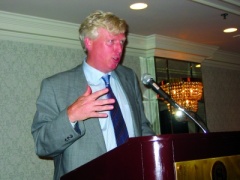
Miller was speaking at a gathering of
CUPE municipal locals in Toronto. (This
groundbreaking, town-hall style meeting
was just the start of a concerted push for a
more connected and coordinated municipal
sector within the union.)
Miller acknowledges that lifting the
GST and getting a share of the gas tax are
big wins for cities. “But,” he cautioned,
“neither is the endpoint of the New Deal.
There is much more to do.” Miller’s wish
list includes housing, transit, child care,
support for immigrants and environmental initiatives.
Before they can start tackling that list,
Miller says cities have to gain more power.
“Although cities are much more important
today than ever before, that reality is
not recognized in Canada’s constitution,”
he told delegates. “The forced amalgamation
[Toronto] lived through showed that,
by law, cities only exist by provincial will.
They are creatures of the provinces. So we
want new powers.”
To build a stronger community, you
also need respect. “It’s about city governments
being partners with federal and
provincial governments,” Miller said.
“Toronto has the second-largest child care
system in the country after Quebec. But
when there are talks about a national child
care plan, we aren’t at the table.”
James Knight is chief executive officer
of FCM. He also thinks there should be
more dialogue between the different levels
of government, and he’s pleased that the
New Deal appears to recognize this.
“It’s important to stress that [the New
Deal] is about relationships,” he says.
“And while the financial relationships are
really important, our current focus is
more on the intergovernmental side.”
Oates says he’s glad that governments
are talking. “But we need to continue the
commitment,” he says, referring to one
concern about the New Deal: it only sets
out funding for five years.
The FCM has pegged the overall
municipal infrastructure deficit at over
$60 billion. Knight agrees that the fiveyear
span of the New Deal could have
been extended, but he has no doubt it’s a
long-term program.
“They could have done a 10-year or a
15-year program, and probably should
have, so municipal governments can plan
with certainty,” he says. “But I think it
would be politically very difficult to
reverse it after five years. It would be very
destructive of the progress we’re achieving
if this program fell off the table.”
Guthrie doesn’t believe the New Deal
will instantly fix every problem. “But
eventually, over the coming few years, it
will be a good deal for Toronto,” he says.
“It has a better chance of working as long
as public accountability is built in and
councillors are the ones making the decisions.”
Guthrie has cause for concern. Some
Toronto councillors have recently proposed
that the city strike an executive
committee that would make key budget
decisions away from the scrutiny of the
whole city council. This anti-democratic
drift is being actively opposed by a broadbased
community coalition, including
Toronto municipal workers.
“The biggest problem is if there are
strings attached on how the city is going
to be governed,” says Guthrie. “It’s in our
interest to be an open city and not have a
small committee running things.”
Ann Dembinski, president of CUPE
79 representing Toronto’s 18,000 inside
workers, agrees. She supports Miller’s lobbying
for an improved New Deal and a
better relationship with the province.
“Toronto needs more control over how
money is spent,” she says. “Our members
have seen the impact of downloading and
cutbacks, and how services have suffered.
It’s time to rebuild them.”
Strong communities for future generations
When public services are neglected or
privatized, the whole community loses –
starting with youth. In St. John’s, Nfld.,
Greg Baker sees young people leaving the
province to work in Alberta’s lucrative oil
patch. Contracted-out city work only
pays $6 or $7 an hour, compared to the
unionized $18 wage.
“The cost of living here is very high,”
says Baker, president of St. John’s outside
workers, CUPE 569. “[Kids] are not
going to hang around here and struggle to
make ends meet, living at home with their
parents until they’re almost 30.”
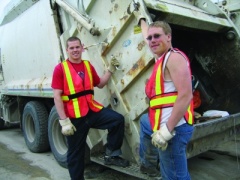
Baker’s local is exposing the problems
with contracting out and privatization at
every turn. Their strategy also includes a
push for a fair wage policy.
“Any contractor that bids on union
work should have to pay at least 80 per
cent of union wages,” he says. “That way,
everybody’s on the same playing field. It
should be the law right across this country.”
Baker says the St. John’s mayor and
council have to move now to protect the
city’s future. “If they’re not willing to
invest in young people in this city, then
this community is a dead community. Ten
or 15 years down the road, there will be a
bunch of senior citizens out plowing the
streets. We need to get young people back
and keep them here to revitalize our workforce
and our union.”
On the other side of the country, protecting
public sector jobs for the next generation
was at the heart of a hard-fought
lockout in Nelson, B.C., in the summer
of 2004. The lockout was forced over
CUPE 339’s refusal to give up a clause
that protected 55 public city services from
being contracted out.
“If we lost [that clause], it would have
just paved the way for privatization,” local
president Bev LaPointe says. “The city
promised to secure our jobs, but once we
retired, there would have been nothing.
No more public services. No more union
jobs for the young people in line.”
Beating back the P3 Goliath
As a member of CUPE 30, Oates has
been fighting privatization schemes in
Edmonton for years. Like his sisters and
brothers across Canada, he knows that
one of the keys to rebuilding strong communities
is keeping the privateers out of
public municipal services.
There is a growing mountain of evidence
that privatization not only hurts
public workers – it usually ends up costing
taxpayers more money for diminished
services. In addition, privatization in the
era of powerful international trade and
investment rules is doubly dangerous.
Such rules make it harder for services to
come back under public control once they
have been privatized.
Despite these and other warning bells,
the federal government makes no secret of
its pro-P3 orientation. Neither do many
provincial and municipal governments.
Infrastructure Canada, the federal department
that coordinates programs like the
New Deal and makes “strategic investments”
in infrastructure, is pushing the
P3 model. In Quebec, Liberal Premier
Jean Charest established the Public-
Private Partnership Agency, which advises
the provincial government on privatization issues.
While he won’t condemn privatization
outright, the FCM’s Knight strongly
believes in the advantages of keeping
municipal services public.
“The reality is that public services in
Canada at the municipal level are pretty
efficient,” he says. “Broadly speaking, we
do public services rather effectively and
certainly with great reliability. And that
presents some challenges to the private
sector, in terms of being competitive.”
Besides, Knight adds, keeping services
public is good for the bottom line.
“Municipal governments can borrow at a
lower rate than the private sector because
they are totally solid credit risks,” he
notes. “They’re not mandated to be profitable.”
However, with the blue-sky scenarios
painted by privatization’s profit-oriented
supporters, it’s perhaps not surprising that
many city leaders and ordinary citizens
have come to believe that there is no alternative.
This makes the influence CUPE
members have – whether as elected officials
or as local lobbyists – even more vital.
At the recent gathering of CUPE
municipal locals in Toronto, members
from across the country shared information,
strategies and success stories. One
point that many participants kept emphasizing
was the importance of forging
alliances and building a broad base of support,
from residents to sympathetic councillors.
“We won because the population was
on our side,” said CUPE 1983 president
Claude Benoît of his local’s winning fight
against a transit P3 in Montreal. “We distributed
100,000 leaflets explaining the
risks of P3s for the whole community, and
we found many, many allies. We made it
clear that keeping it public benefits everyone.”
“It’s hard to break in when you work
alone,” says anti-racism activist Tam
Goossen, who took part in the town hall.
“We all feel powerless as individuals, but
we’re not alone in the fight.”
The Toronto Environmental Alliance’s
Shelley Petrie has seen the results strong
partnerships can achieve. “When we work
together, we’re no longer just running
reactionary campaigns,” she told participants.
“We can also be agenda-setters. The
campaign for pesticide-free parks in
Toronto is just one example. We couldn’t have done it without the workers. We’ve
had many wins hand in hand with labour.”
Another good approach is to build
awareness of city workers’ contributions
to their communities outside of crisis situations.
Many members all over Canada
already participate in their local charities,
churches, sports and cultural events.
These activities also provide opportunities
to remind people that if they can enjoy
attractive parks, tidy streets and safe facilities,
they can usually thank a municipal worker.
“People don’t live in Regina for the
weather,” jokes Tim Anderson, president
of that city’s outside workers, CUPE 21.
“They’re here for the quality of life, and
good municipal services are part of that.”
Time after time, Regina’s municipal
services get top marks in resident surveys.
“For example, we look after the recreation
side of life,” he says. “When you get home
from work, there’s always somewhere you
can go to get away. There are affordable
sporting programs for kids. That’s a really
important comfort zone.”
Mayor Miller is on the same wavelength.
“Workers are all about building a
great city,” he told members. “It’s not just
a job. [They’re] doing it for the families
that live in our cities. And [they] are
among those same families.”
Rocking the vote
At CUPE’s town hall, another message
came through loud and clear: concerned
members have a responsibility to use their
influence to affect the outcomes of
municipal elections.
“It’s not going to be by accident that
we take over our cities,” the Canadian
Labour Congress’ Mike MacIsaac told
delegates. “It’s going to be by planned,
strategic votes.”
Talk to just about any CUPE municipal
worker, and they’re planning to work
harder – and smarter – in their next
municipal election.
Ken Davidson, a Vancouver outside
worker and president of CUPE 1004, says
the local labour council played a big part
in electing a progressive mayor and socially
conscious councillors in the city’s 2002
elections. The council helped coordinate,
support and train activists.
In Nelson, B.C., CUPE 339’s president
says her members know what’s
expected of them in this fall’s municipal
elections. “We have to elect councillors
who don’t buy into the lie that private is
better,” LaPointe states. “Then we stand a
fighting chance.”
“Keeping on top of city hall in between
elections is as important as getting
involved in elections,” says Davidson.
“We really have to pay close attention to
who we get elected and how we hold
them accountable. It can’t just be action
and contact every three years. It has to be
every day.”
LaPointe and Davidson, like municipal
workers across the country, realize the
stakes have never been higher.
“Municipal services are the heartbeat
of the community,” LaPointe says. “They
weave the social fabric. The taxes I pay go
right into workers’ wages, and they spend
that money in town. You have a say, it’s
transparent and you can see what’s going
on. That’s local economy. That’s local democracy.”