
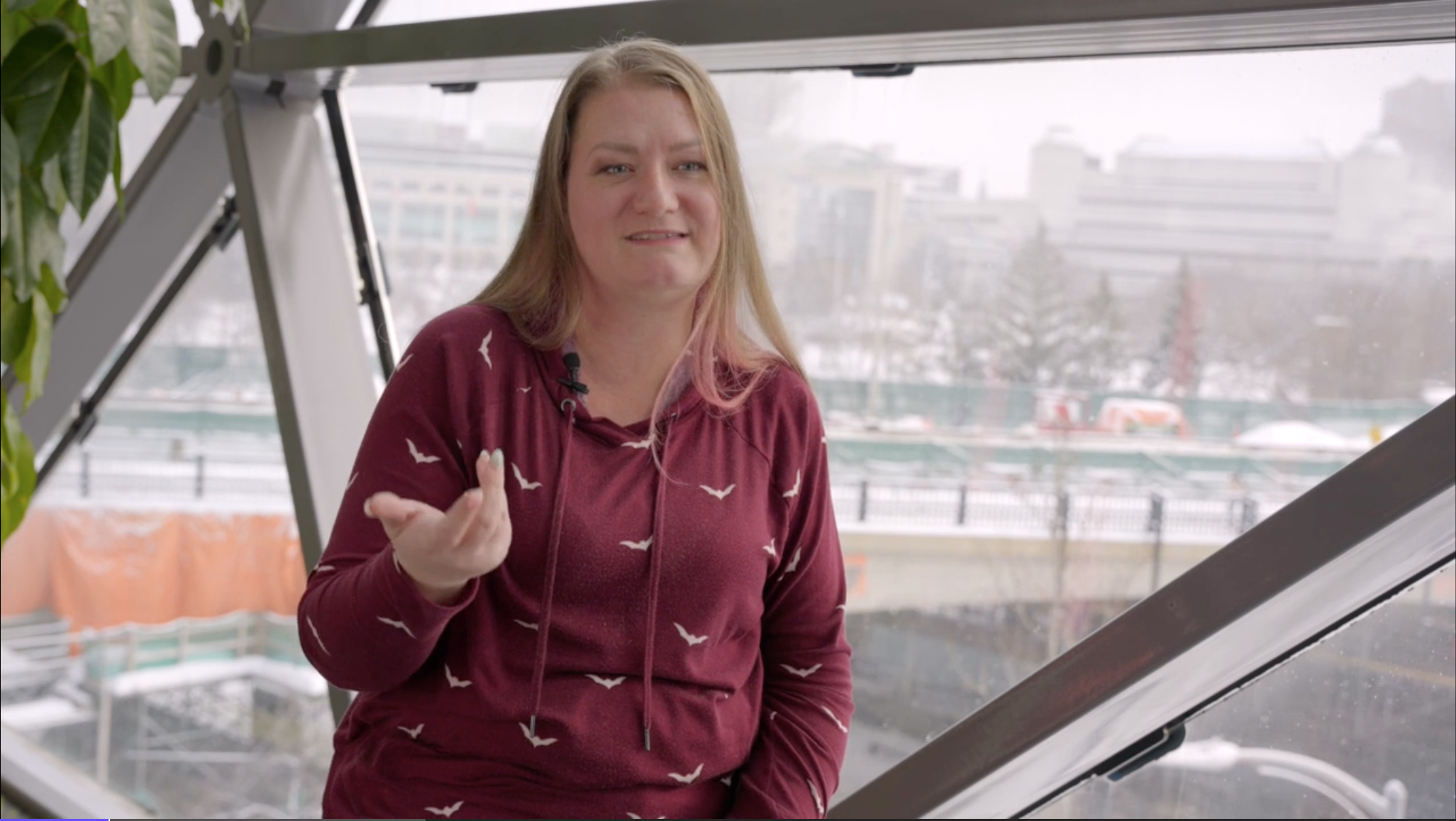
While public libraries are often pictured as quiet places where people read books, they have evolved into so much more. According to Leah Freitag, a customer service supervisor in the Regina public library system and president of CUPE 1594, libraries are dynamic community hubs. They provide a wide range of services, and they also face growing health and safety challenges.
Leah’s role involves supporting front-line workers and coordinating staffing across a large branch. Ensuring that every area is covered requires careful day-to-day planning. “It’s a big puzzle that I put together every day,” she says, adding that she loves the challenge of making sure the library runs smoothly.
Leah highlights that while books remain an important part of the library, reading materials are only one piece of what libraries now offer. Many people rely on library internet services to communicate with family, attend online job interviews, or access social services. Libraries also host language classes for newcomers learning English, community events, and skill-building programs such as cross-stitch workshops, paint nights, and language conversation circles. Leah’s branch also includes a digital media studio where people can record music, use green screens for video production, edit content, and experiment with tools like 3D printers.
Leah is also proud to be an outspoken advocate for the library’s ability to host drag story times. For her, these events represent the core mission of libraries: providing access to diverse perspectives and ensuring that all members of the community feel represented.
“If we start to silence one perspective, we risk silencing others as well,” she explains. Libraries aim to reflect the diversity of the communities they serve. Ensuring that programs and materials represent different identities and viewpoints helps create a welcoming environment not only for patrons but also for staff.
Leah says children who attend drag story times often respond with curiosity and excitement, drawn to the creativity and colourful storytelling. For some families, these programs provide important exposure to different ways of expressing identity and self-acceptance.
But with this expanded role, health and safety concerns in libraries are front and centre for Leah and her colleagues. Because libraries are open, zero-barrier spaces, everyone is welcome to enter – and many visitors are experiencing significant challenges.
“People can come in from any walk of life, and we want them to have a safe space. But because we’re often accepting people at their lowest, sometimes they aren’t safe,” Leah adds. “We have to balance the needs of these individuals with the safety of library patrons and staff.”
As an active member of regional and national occupational health and safety committees, Leah appreciates that CUPE has designated 2026 the Year of Health and Safety. In particular, she highlights the growing importance of psychological health and safety in workplaces that interact heavily with the public.
“There is a new world of psychological health and safety that we’re still learning a lot about. It’s hard right now for a lot of people. And for library workers, there’s also the mental load on top of a job where they work in the public and see the hardships in their own community. I don’t think we’ve scratched the surface of what the long-term impact of these challenges will be for library workers. I think we need to continue to raise awareness about psychological health, have those conversations, take the stigma away from mental health, and reinforce the fact that it is okay to not be okay.”
Despite these challenges, Leah feels fortunate that her organization provides security, training, and protections for workers. She notes that other public-sector employees, such as child care workers, may face difficult or unsafe situations without the same level of support.
Looking to the future, Leah believes the biggest changes needed to improve safety in libraries extend far beyond the library walls. She describes libraries as “society’s Band-Aid,” filling gaps left by underfunded and scarce social services in communities.
To truly improve safety and well-being – for both library users and staff – communities need stronger supports such as housing services, addiction treatment, mental health care, and safe consumption sites. Without those resources, many people turn to libraries as their primary place of refuge and assistance.
“Libraries are strong and we will hold things together,” Leah says. “But we shouldn’t have to do it alone.”
By strengthening community services and investing in community supports for people in need, Leah hopes libraries can continue to be welcoming spaces while ensuring that the people who work there remain safe, supported, and valued.