
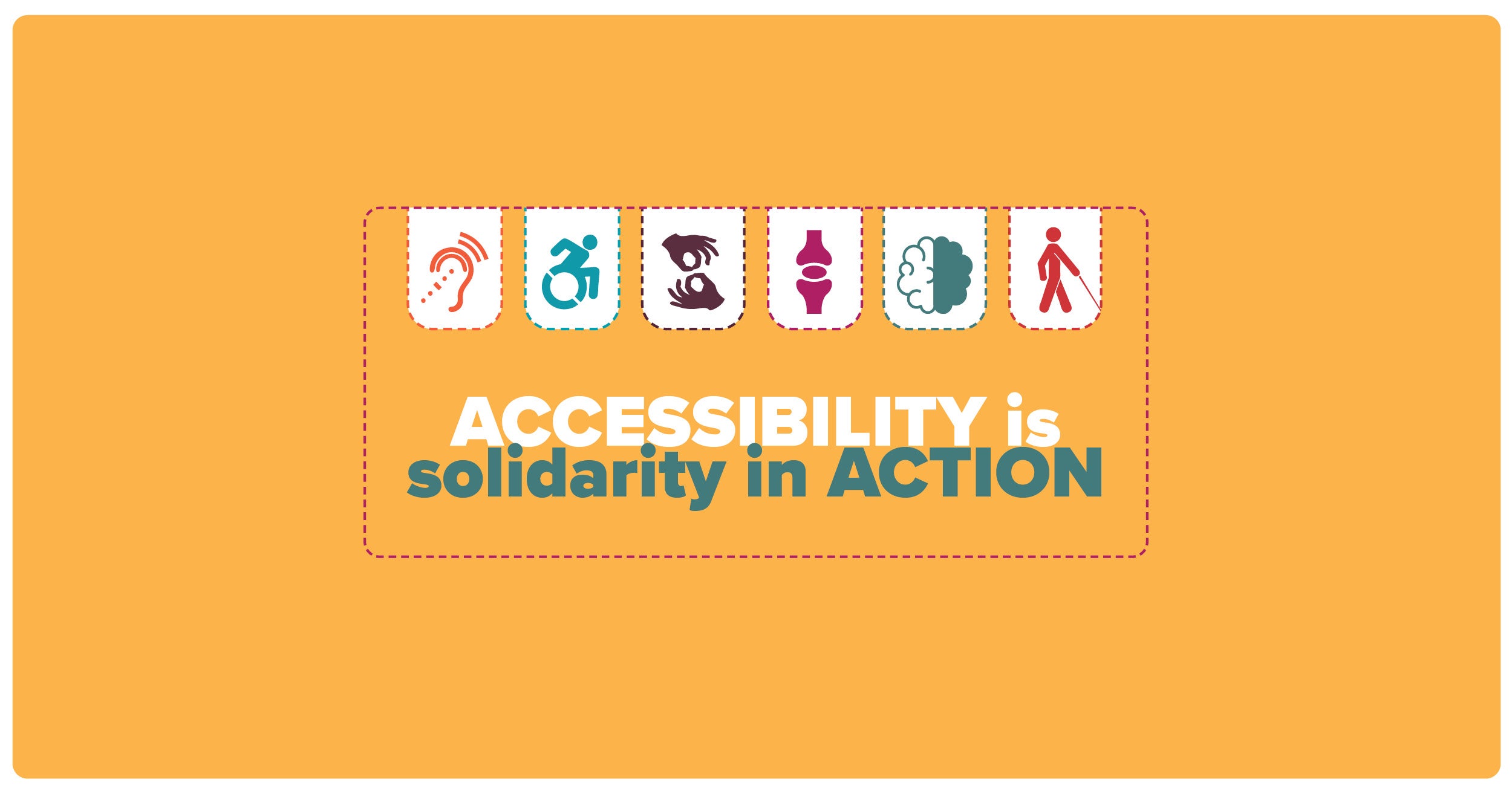
CUPE is committed to the full inclusion and participation of persons with disabilities in all aspects of life. As a union, we have the power to advance disability justice in the workplace and beyond. This factsheet aims to raise awareness and educate CUPE staff, CUPE members, and all those living in Canada about the multiple facets of disability.
Disability justice is a framework to advance equity, solidarity and human rights in our union. This framework, developed by Sins Invalid, builds on disability rights and centres the leadership of Black, Indigenous, racialized and 2SLGBTQI+ people with disabilities. Disability justice looks at how racism, sexism, classism or other systems of oppression interact and create compounding barriers.
The diversity of disabilities
A disability is a condition that affects how a person moves, thinks, or interacts in the world. However, people are often disabled not just by their conditions, but by barriers in society, such as inaccessible spaces, workplace rules, or negative attitudes.
Every disability is unique to the individual experiencing it. In Canada, roughly 8 million people aged 15 years or older - nearly 28% of the population - have a disability or multiple disabilities.
People with disabilities who are also marginalized by racism, gender discrimination, or transphobia face additional barriers. Some communities are more likely to experience certain disabilities, for example, the universities of Manitoba and Toronto, respectively, found that Indigenous and South Asian people in Canada are three times more likely to develop diabetes.
Ableism is any form of discrimination or bias, whether conscious or unconscious, against people with disabilities. Ableism is reflected in harmful attitudes, beliefs, policies or practices that falsely judge people with disabilities as inferior.
Disabilities can be temporary, episodic, permanent or chronic. Some people are born with a disabling condition, like spina bifida. Some people acquire a disability, like diabetes, over the course of their life while others become disabled as a result of an accident, and some people have invisible disabilities such as Autism or Crohn’s disease.
Physical disabilities
Among workers with disabilities, pain-related (63%) and flexibility (36%) were the most common physical disabilities in 2022.
In 2022, 7.4% of Canadians aged 15 years and over had a seeing disability. Despite the fact that, on average, Canadians with vision loss attain a higher educational level than other people in Canada, they face higher unemployment and underemployment rates than other people with disabilities in general.
An estimated 357,000 people in Canada are culturally Deaf, meaning they were born Deaf. Three and a half million people in Canada have some degree of hearing loss.[iv] Less than half of working age people with a hearing disability are employed.
Vision and hearing challenges will become increasingly common as our population ages.
| Deaf is capitalized because it means they are part of the Deaf community. Some people see it as their identity, and for some, less so a disability. |
Invisible disabilities
The challenges imposed by disabilities are not always visible.
Many people picture wheelchairs, guide dogs, and other more obvious signs of disabilities, but not all workers with mobility issues require a wheelchair, and not all visually impaired workers are completely blind. Disabilities like autism, depression, arthritis, or attention-deficit/hyperactivity disorder (ADHD) are not visible.
Invisible disabilities can require accommodations that are not obvious to others, such as flexible work arrangements. People who have invisible disabilities can face stigma and discrimination, including disbelief that their disabilities exist.
It’s important to avoid making assumptions about a person’s health status or disability.
Perceived disabilities
Sometimes workers are discriminated against because an employer or co-worker perceives them to be disabled when they are not.
Consider a worker returning to work following a heart attack with full medical clearance and who has been told by her employer that she cannot perform certain tasks. This worker is being discriminated against because she is not allowed to perform her job. This discrimination is the result of a perceived disability, not based on fact, which can create barriers for workers.
Neurodiversity
Neurodiversity means that people’s brains work in different ways. These differences are a normal part of human diversity.
“Neurodivergent” describes people who process information, communication or behave differently from what is considered neurotypical, or most common. Some neurodivergent conditions may be considered disabilities, especially when workplace or social barriers make it difficult for a person to fully participate. For example, a worker with ADHD may face challenges in a rigid work environment but can succeed with accommodations such as flexible scheduling or task supports.
Some other examples are:
- Autism spectrum disorder
- Learning disabilities
- Obsessive-compulsive disorder (OCD)
Recognizing neurodiversity helps workplaces reduce stigma and provide appropriate accommodations so all workers can thrive.
Mental disabilities
Mental disabilities can take many forms, and symptoms may not be obvious to employers and co-workers. In 2022, 46% of workers with disabilities had a mental health-related disability, the second most common type of disability among workers after pain-related disabilities.
Among youth (aged 15 to 24 years) with disabilities, 68% of them had a mental health-related disability. Anxiety disorder and depression are the most common.
Other mental disabilities include, but are not limited to:
- Bipolar disorders
- Dyslexia
- Memory problems
- Schizophrenia
- Phobias
Mental health in the workplace
Stress can be associated with severe physical and psychological effects, including sleep disorders, fatigue, depression, susceptibility to injury, and a compromised immune system.
Stress is often a part of life and the workplace but someone’s capacity to handle everyday stress is shaped by factors such as housing, economic stability, war and conflict, experiences with trauma and more. In many cases, stress and anxiety are caused by poor working conditions, steadily worsened by privatization as well as racism, transphobia, ableism and more.
Recognizing toxic levels of stress and mental health are a part of workplace health and safety. Employers have a responsibility to prevent harm caused by workplace conditions while also meeting their duty to accommodate.
Substance dependence
Substance use disorder, addiction or substance dependence are terms often used interchangeably and are considered a disability.
According to the Canadian Human Rights Commission, the worker, the employer, and the union all have a responsibility to address substance dependence in a respectful, collaborative and timely manner.
Workers are required to disclose accommodation needs though often do not because of stigma and discrimination. Employers have a duty to inquire in a confidential, non-judgmental manner if there are signs that substance dependence might be impacting a worker’s job.
The Canadian Drug Policy Coalition stresses the importance of workplace responses that focus on actual safety, early support and accurate assessment. Supportive, non-stigmatizing accommodation and health and safety processes are crucial.
Episodic disabilities
An episodic disability is experienced when a person goes through periods of ill health when they require accommodation or are unable to work. Often, accommodations required include accommodating absenteeism, understanding the inability to predict absences, flexible work hours, and working from home.
Some examples include:
- Arthritis
- Crohn’s disease
- Long COVID
- Post-traumatic stress disorder (PTSD) or Complex post-traumatic stress disorder (CPTSD)
- Repetitive strain injury
Advances in medicine have made it possible for people with chronic conditions like lupus, HIV and AIDS or cancer to live full lives and continue to work. But sometimes chronic conditions flare up. The cause may be unknown or even result from stressors in the workplace. Treatments can also take physical, emotional and financial tolls that must be considered.
Sometimes disabilities can be triggered in the workplace. People with occupational asthma, for instance, may be completely free of symptoms as long as they work in an area with no irritants.
Regardless of the cause, people suffering from episodic disabilities are entitled to protection from workplace discrimination just as those with other forms of disabilities.
Temporary disabilities
There are cases where temporary conditions have been considered disabilities, including for injured workers.
Some examples of temporary conditions are:
- Heart attack
- Broken bones, sprains and joint injuries
- Fibromyalgia
- Intermittent back pain
- Carpal tunnel syndrome, tendonitis, and other repetitive stress injuries
Some of the conditions listed above can also be recurring or chronic conditions, but the flare-ups from the conditions can be temporary.
Temporary disabilities are not the same as episodic disabilities. A temporary disability eventually ends, while episodic disabilities may recur indefinitely. While these categories are distinct, they are not always mutually exclusive. A condition may fall into more than one category depending on the duration, its effects, reoccurrence, and other factors.
Disability justice and equity
Applying a disability justice framework to disabilities in the workplace can foster a diverse, inclusive and equitable workplace and union. Sins Invalid’s disability justice principles promote leadership of the most impacted, cross movement organizing, cross disability solidarity and are valuable goal posts for workplaces and unions working in solidarity with workers with disabilities.
Download
