

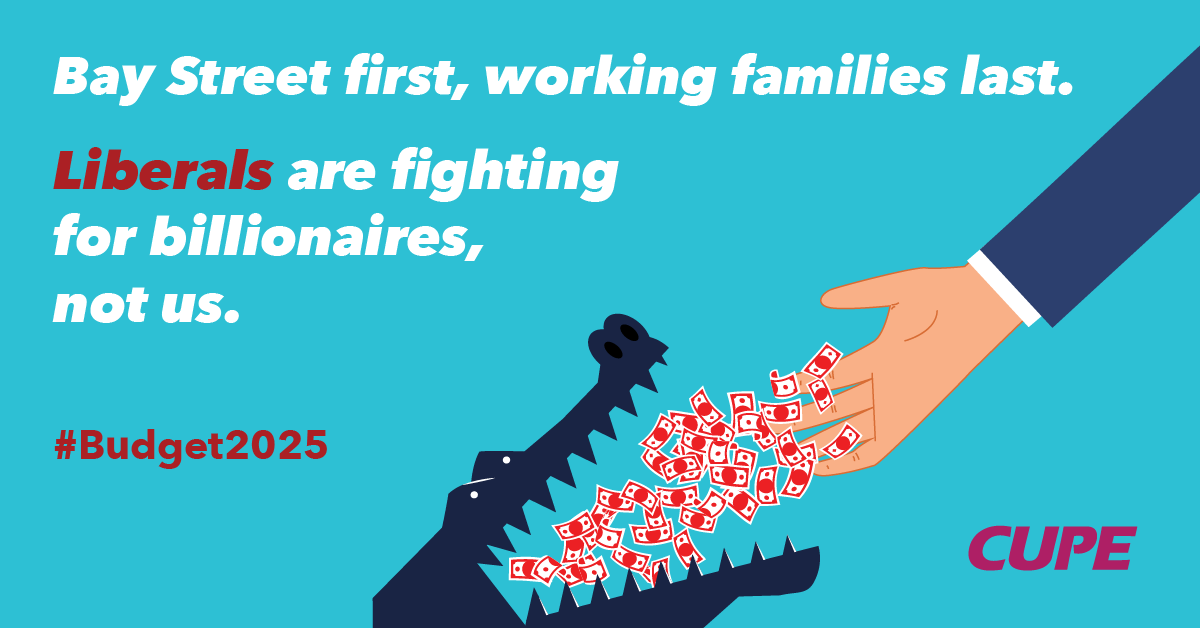
With every announcement from the new Liberal government, especially Budget 2025, it might be tempting to look back on the Justin Trudeau years with rose-coloured glasses. However, when we look at the progressive policies implemented by his government, it’s important that we remember that policy measures that advance workers’ rights or make society more equal don’t stem from government goodwill alone. Wins like anti-scab legislation, pharma and dental care are the results of hard-fought battles led by unions and their allies. As workers, we can never take for granted that governments will look out for our best interests.
Because most people learn about government actions through announcements delivered via the news or social media, the struggles and efforts behind progressive policy developments are mostly invisible. This is in part because governments will always take credit for progressive policy moves, regardless of how big or small they are. For example, Carney’s Budget 2025 is quick to take credit for the pharmacare, dental care, and child care programs launched under Trudeau. But it doesn’t include any plans to allocate more funding or develop these life-changing programs to their full potential.
These programs were introduced under the Trudeau Liberals, but they became a reality because of sustained pressure from the NDP. That pressure did not emerge in a vacuum: it reflected years of advocacy and organizing by civil society organizations and the labour movement — work that is deeply embedded within the NDP.
In many ways, it’s fair to say that most government decisions are influenced by pressure and advocacy from various groups or organizations seeking to advance certain interests and policy goals, both good and bad. For example, Mark Carney met face-to-face with Goldy Hyder, CEO of the Business Council of Canada, just days after being elected. The Business Council of Canada represents the CEOs of over 170 of Canada’s largest corporations, its board of directors is made up of people like Loblaws billionaire Galen Weston, and CEOs from fossil fuel companies and major banks.
The Business Council of Canada played a notable role in shaping economic policy in the 1980s and 1990s, particularly in advancing the pro-corporate agenda that informs our governments’ priorities to this day. But it wasn’t always like this. Before the 1980s, labour was more meaningfully consulted on industrial and labour policies. This role was not simply handed to us, it was won through the militancy and strength of organized labour.
And we are seeing a resurgence of that militancy and strength today. Over the past five years, there has been a renewed sense of urgency among CUPE members and labour activists across the country. We saw it most recently with Air Canada flight attendants, when the Liberal government used section 107 of the Canada Labour Code to end their strike. Our members stood their ground and refused to let the government trample on their right to bargain.
Across the country, every day, CUPE members are coming together and forcing governments reckon with our power. Municipal locals stand up for clean and safe drinking water, like CUPE 830 who held the line for over 100 days in Charlottetown, PEI. Education workers are fighting for quality public education, like the locals in Saskatchewan who are developing a plan for sector-wide coordinated bargaining, or the members in Alberta who stood up to Premier Danielle Smith. There are countless examples. Across every sector, in every province, CUPE members are making their voices heard.
It’s undeniable that certain groups — specifically those representing the wealthy and powerful — have more privileged access to our government and elected leadership. But that is no reason to give in to hopelessness and despair. Mark Carney may not want to listen to workers, but CUPE’s 800,000 members will leave him no other choice.


